
Field notes 13 / swearing cylinders, reverse speech, voices in the static
The Reverse Signal
A Documentary Field Guide to Backmasking
History, technique, hidden messages, imagined messages, and the strange things the human mind does when the tape begins running the wrong way.
Listening protocol: Play each evidence tape before revealing its suggested phrase. Once words are supplied, they can be remarkably difficult to stop hearing.
Reel 01 / fundamentals
Reverse the Signal
Backmasking is usually described as though it were one phenomenon: play a record backward and a hidden sentence crawls out. That description is memorable. It is also too simple to be useful.
First, Separate Three Different Things
Deliberate backmasking
Speech or another sound is intentionally reversed and placed into a recording so that its intelligible form appears only when playback is reversed. The concealed direction is part of the composition.
Reverse recording as a studio technique
A guitar, voice, cymbal, tape loop, or entire passage is reversed for texture. It may create an uncanny attack and decay without spelling a message. The Beatles’ official history of the Revolver sessions documents backward guitar and experimental tape loops; “Rain” lets you hear the reversed vocal ending in the released recording. [source] [source]
An alleged phrase
Ordinary recorded sound is reversed and interpreted as language even though no message has been demonstrated to have been planted. Some readings feel obvious after the words are printed beside them; without that prompt, listeners may report entirely different phrases.
Those categories can overlap in folklore, but they should never be silently exchanged. This guide labels intentional constructions, documented production techniques, historical allegations, and psychological interpretations separately.
What Reversal Actually Does
A digital recording is a sequence of amplitude samples. A reverse operation changes their order: the final sample becomes the first, the next-to-final sample becomes the second, and so on. Audacity’s official documentation describes the operation plainly as making the selected audio play from end to start. [source]
The consequences sound stranger than that simple rule suggests. Musical attacks become decays. A sharp drum hit can swell toward an impossible impact. Reverberation appears to gather itself before the source arrives. Speech does not merely become a sentence with its letters rearranged: consonants, vowels, breath, room reflections, and transitions between sounds all unfold in reversed time.
1 → 2 → 3 → 4 → 5
⇄
Reversed samples
5 → 4 → 3 → 2 → 1
That distinction matters. To plant a message, record the intended words, reverse that recording, and mix it into the song. Reversing the finished mix returns that voice to its original direction while sending the surrounding music backward. Two exact digital reversals cancel each other; any remaining change comes from mixing, processing, editing, or the recording chain—not from reversal wearing the sound out.
Three Controls That Do Different Jobs
Reverse changes the order of time. Invert flips sample polarity without changing their order; it will not decode backward speech. Change speed changes duration and pitch together unless a separate time-stretch process is used. Slowing a voice into a growl is an extra operation, not a property of backward playback. [source] [source]
1878: The Cylinder Starts Swearing
Long before listeners hunted for hidden messages by spinning vinyl records backward, experimenters were reversing sound on the earliest phonographs. In 1878, tinfoil cylinders were already being played backward, and contemporary descriptions called the musical possibilities a “musical kaleidoscope.” [source]
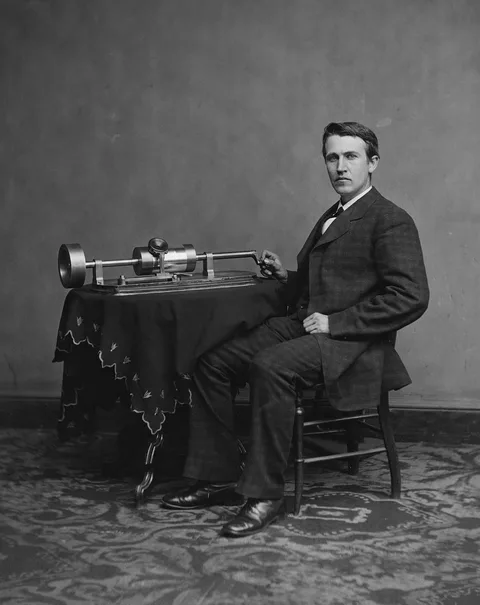
Thomas Edison’s February 19 letter to William Henry Preece described reversed songs as surprisingly tuneful. A July 9 newspaper report had him joking that Jacques Offenbach’s music improved backward, and that familiar tunes could be reversed and sold as new material. [source]
Then there is the less respectable demonstration. A report reprinted in the Scientific American Supplement on March 16, 1878 describes Edison recording “Mad dog!” repeatedly, then amusing himself by reversing the crank. The reporter does not spell out the resulting profanity. [source] A separate May 23 account names his assistant Charles Batchelor: before a distinguished audience, the reversed phrase was heard as “God damn.” Sound historian Patrick Feaster traces both the machinery and the contemporary reports. The machine was barely out of infancy and someone had already taught it to swear. [source]
Before the Button Marked “Reverse”
Digital editors can reverse a selection in a single operation. Tape demanded physical planning. Engineers could turn a reel over, route tape through a machine in the opposite direction, create a reversed copy, or build loops that were manually fed across several machines. The exact method varied with the studio and the desired result.
The technology encouraged experimentation because reversal transformed familiar material so radically. A normal performance could become an unfamiliar instrument; speech could become an indecipherable texture; a texture could become speech again when a listener reversed the finished recording.
The machine does not discover intent. It only changes direction.
Whether a phrase was planted, accidentally resembles speech, or exists mainly in the listener’s expectation is a separate historical and evidentiary question.
Messages Made to Be Found
Start with one constructed message. ELO’s “Fire on High” supplies a useful reference: a voice made difficult to understand in the released direction, then recoverable when the recording is reversed.
Listen for the voice emerging from the arrangement, not merely for a few syllables matching a caption. The message comments on the act of reversal itself. The collected song history identifies drummer Bev Bevan as its speaker; Reel 06 examines the sources behind that attribution. [source]
Listen Before the Label
The evidence players hide their suggested transcriptions by default. That is not a gimmick. Printed words create a powerful listening frame, especially when the sound is ambiguous.
You only get one first listen. If you already know a case, record that too. Familiarity is part of the listening conditions, not something to quietly subtract from the result. The research and an interactive comparison are in Reel 05.
Underground Noize listening protocol
- Play the clip without opening the transcription.
- Write down what you hear, if anything.
- For a composite archive, hear the complete forward/pause/reverse sequence untouched; use A/B only when a case supplies separate matched assets.
- Reveal the alleged phrase only after making your first judgment.
- Treat resemblance, documentation, and intention as three separate questions.
Next, leave the decoder on the bench and move to the recording side of the glass.
Research ledger / Reel 01
Sources & Field Notes
-
“A Compass of Extraordinary Range”: The Forgotten Origins of Phonomanipulation
Patrick Feaster / ARSC Journal 42(2), 2011, pp. 163–204
See pp. 171–174 and notes 38–46: contemporary reversal experiments, Edison’s Preece letter, the July 9, 1878 Offenbach report, and the May 23 Batchelor account. Historical reports, not a surviving audio exhibit.
-
The Speaking Phonograph
Scientific American Supplement, March 16, 1878, p. 1828; reprinted from the New York Sun; Phonozoic transcription
Contemporary account explicitly describes Edison recording “Mad dog!” and reversing the crank. The text does not print the resulting profanity. Its other fanciful descriptions should not be mistaken for a precise acoustic transcript.
-
Reverse
Audacity Manual
Official documentation for digital sample reversal.
-
Invert
Audacity Manual
Polarity inversion changes sample signs, not their order in time. It is not backward playback.
-
Change Speed and Pitch
Audacity Manual
Explains linked changes to speed, duration, and pitch, and distinguishes them from tempo changes that preserve pitch.
-
Rain
The Beatles
Official video of the released recording; hear the reversed vocal ending. The linked Revolver artist recollections provide production context.
-
Announcing Revolver Special Editions
The Beatles
Official session history and 2022 release inventory, including Rain Take 5 at actual and slowed speeds, mono/stereo mixes, and I’m Only Sleeping session recordings.
-
Fire On High — documented song history
Jeff Lynne Song Database
A collector-maintained source compilation. Contemporary Trouser Press coverage and later album commentary attribute the voice to Bevan; the 1986 Bevan excerpt concerns playing the song live, not recording the message. Keep interview excerpts separate from editorial interpretation.
Archive policy: intentional examples are identified separately from allegations. Uncertain claims remain labeled as uncertain, and exact quotations will not be attributed without a traceable source.